
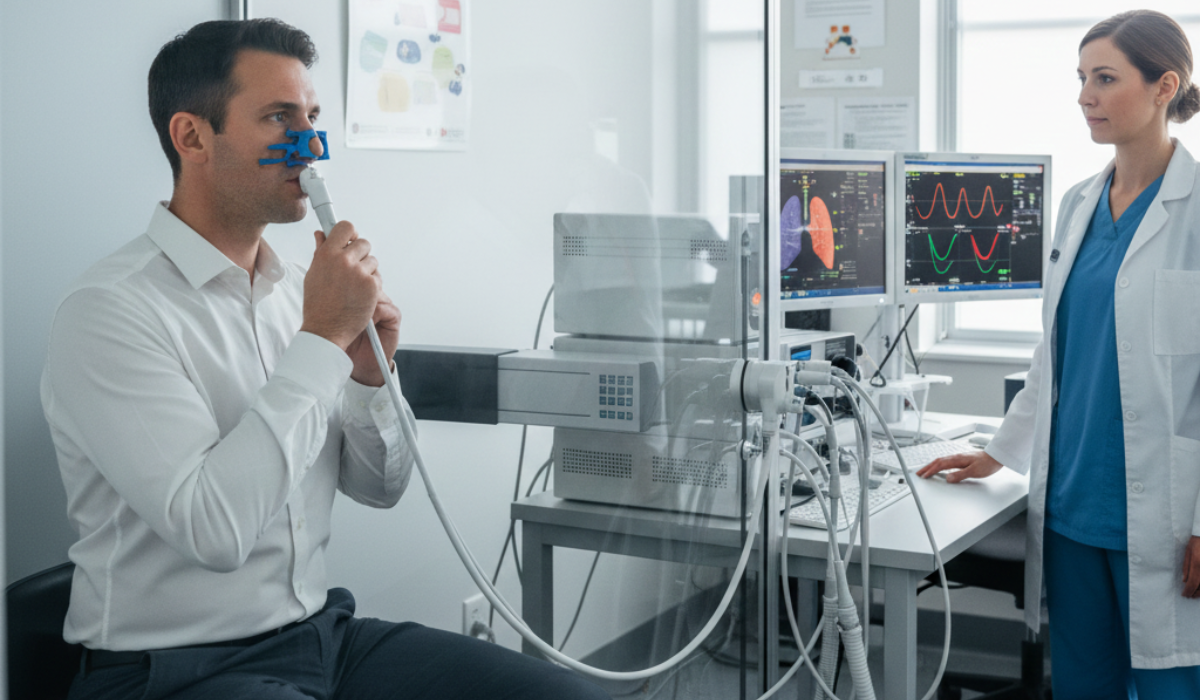
The Pulmonary Function Test (PFT) is a non-invasive breathing test to assess, monitor, and evaluate lung functionality. This test measures your lung health, including airflow through the airways, gas exchange between your lungs and blood, and lung volume.
If you are getting your PFT for the first time, then this how-to tutorial is for you. A lot of people have a myth that PFT is just one test, but you are wrong. And do you know what the PFT report includes and what it says? Understanding the test types and reports will help you focus on areas where you are falling behind.
PFT Tests and Reports
Some of the common types of PFT tests include Pulse Oximetry, Bronchodilator Tests, Lung Volume Testing, Spirometry, Walking Tests, and other medical tests. In the PFT report, you’ll see some PFT parameters like FEV₁, FVC, FEV₁/FVC, TLC, and DLCO. Each defines different aspects of your lung health.
- Forced Expiratory Volume/Forced Vital Capacity (FEV₁/FVC) tells you about the airflow and obstruction.
- Total Lung Capacity (TLC), Residual Volume (RV), and Vital Capacity (VC) indicate the size and restriction of the lungs.
- Diffusing Capacity of the Lung for Carbon Monoxide (DLCO) tells you about the efficiency of gas exchange.
So, how can one prepare for a Pulmonary Function Test? Are there any guidelines and suggestions? Of course, yes. Let’s help you out in preparing for the PFT test.
What to Do Before a PFT Test?
If you are planning to undergo a lung test such as a Pulmonary Function Test (PFT), follow these key guidelines to ensure accurate results on the day of the test.
- No Intake of Lung Medications: Before a PFT test, you should temporarily stop taking any prescribed lung medications, unless otherwise advised by your doctor. The gap between lung medications and the PFT test should be 4 to 12 hours, or more, depending on the type of lung medications. However, you can take medicines related to other health conditions, but only after consulting your physician.
- Say No to Smoking, Alcohol, and Vaping: Don’t smoke, drink, or vape before the PFT test, as this results in inefficiencies in the test results and won’t reflect the accurate parameters of your lung function. Alcohol consumption before taking PFT can slow down your respiratory system and inhibit you from breathing properly during the test. Smoking or Vaping before a PFT can narrow your lung airways and irritate the respiratory system, making it difficult for you to breathe properly during a test.
- No Extensive Training: Exercising regularly is good for health, but heavy lifting and prolonged training can affect your PFT results. So, train lightly on the test day.
- No Heavy Meals: If you eat heavily before the PFT test, you won’t be able to breathe properly because your stomach gets pressed against the diaphragm. You won’t be able to inhale or exhale completely. You are limiting your lungs from expanding fully. So, it’s always recommended to avoid heavy meals before the test. Keep at least 2-3 hours of gap between post-meals and the PFT test.
- No Caffeine or Beverages: Don’t consume any soft or hot drinks like tea, coffee, or soda before the PFT test. Doing so can affect the accuracy of your lung function test results. Caffeine is a part of the methylxanthine family, a drug type that’s used to treat asthma. When you consume any caffeine-related beverage, your airways widen, allowing you to breathe freely. But this is only for a temporary period. Consuming tea or coffee before the PFT test can result in producing higher-than-usual readings.
Conclusion
The Pulmonary Function Test (PFT) provides an overview of how your lungs are working at present. Don’t smoke or vape before the PFT test. No alcohol consumption, caffeine intake, or heavy meals. If you are taking any medicines for asthma, bronchitis, or any respiratory issues, consult your doctor and discuss whether you should continue or pause the medication on the day of the PFT.
Are you thinking of getting a PFT in Canada? Book your appointment here.
FAQ’s
No, you don’t need to go for the PFT test on an empty stomach. You can have food as usual; however, eat lightly on the test day. Don’t consume any caffeine-related drinks.
Yes, you can work out on the day of your PFT test, but don’t do any heavy lifting or prolonged training. You can do basic warm-up exercises. Keep your body rested for at least two hours before the test.